Our Impossible Adoption Story
If you're looking for the unbelievable account of how "impossible" became "done" in 5 business days, start here.
Hitting
%20your%20toddler%20to%20not%20hit.) My name is Lex. And I have a violent toddler.
My name is Lex. And I have a violent toddler.
Not really. I don’t think so. Not intentionally.
He’s there, though, in that stage where he’s learning his emotions and his strength and certain social implications and behaviors.
And at first I freaked a little ’cause I couldn’t imagine where he was getting this idea from. I’m pretty sure he’s never seen a person hit another person out of frustration or anger.
This isn’t the-baby-doesn’t-know-what-he’s-doing hitting, either. He knows. I don’t let him get into something he wants, and he yells and smacks me. It’s deliberate, and it’s definitely related to his negative emotion.
But I’m told that it’s normal. It’s a stage toddlers go through.
I’m also told there isn’t a whole lot to do about it at his age except model appropriate behavior. Because he’s too young to understand punitive action like time-outs or spankings.
Which is seriously long-term planning, and seriously hard because no one hits people around here, but neither are we great about calmly working through our disappointments and frustrations. We’re getting better, especially with watchful eyes around, but we’re – um – passionate people. Tables and door frames have felt our wrath. On occasion.
I really want there to be an easy answer, but everything I read seems to give a few suggestions and then fall back on, “And most importantly, continue to model calm, appropriate behavior when you face frustrations …”
Which isn’t to say I’m not trying those other things:
Convert the hit into a positive experience. Intercept it, and make it a high-five.
This kind of works – when I’m really on my game, and paying attention because I’m fully present in the situation, and have a free hand to high-five with, and am awake enough to move that fast … which is pretty much never. Read more…
December Through the iPhone
New Year’s Eve, husband and I sat in bed, watching a movie on the MacBook, dozing on an off (mostly me), and playing on our phones. When midnight struck, we shook our fists in the air to send it off, and went back to what we were doing. 2013 wasn’t a great year, and December didn’t even try to make it up to us.
Most of December was fine, actually. I started and ended it with the family that we don’t see as often as the rest. My baby turned one (… year). Christmas and all that.
December had me stumped at first, which seemed fitting. I stared at a collection of quick, random (and too often boring) pictures that have collected on my phone, and thought, “Meh.” Back and forth, back and forth, not inspired.
And then: Pairs
Is that weird? Little bit? But there it is. Twosies, twosies.

A pair of kings, a pair of baby legs in skinny jeans, a pair of sopes. Read more…
The Skinny on Plastics
 He had his first birthday and then Christmas. He’s been eating more solid food, learning to drink from a cup, and I’m already trying to decide which toys to donate because his collection doesn’t fit in his room.
And almost all of it is plastic.
Bowls and cups are plastic. Toys (which, of course, get chewed on and carried around in his face-pocket) are plastic. And everything is gloriously labeled “BPA-Free!” but, still, my mommy vibe was tingling and I decided I needed to know more about plastics.
(Okay, really what did it was that he got a plastic sippy cup, and I asked Husband to wait on removing the packaging ’cause we might not keep it. I knew glass was better, so we got him a glass training cup, but when I started to tell someone else that I wasn’t super thrilled about all the plastic in his life, and got the half-eye-roll, I decided I really needed to know what I was talking about.)
Keep reading (or skip to the bottom) for a petition that needs your signature and a sweet giveaway!
How To Make Plastics
Plastics are made from oil. Oil is a carbon-rich raw material, but synthetic materials are added and manipulated to make an almost endless variety of plastics that vary in color, texture, strength, flexibility, etc.
What are Endocrine Disrupters?
Some of the synthetic pieces that get added to plastics qualify as, “endocrine disrupters.” Endocrine disrupters send false signals to the body, telling it that the hormone estrogen is present where it is not. They are also sometimes referred to as “estrogrenic activity (EA) chemicals,” or chemicals having EA.
These chemicals are pulled from plastics, either by direct contact with a person (i.e. chewing on plastic), or by contaminating food and beverages that are stored in them. They can cause a variety of developmental and reproductive problems, and children – from the unborn to toddlers – are especially vulnerable to them.
What is Bisphenol A (BPA)
BPA is probably the most famous example of an endocrine disrupter. It was used in polycarbonate plastics, which break down over time, releasing the BPA.
Human testing of endocrine disrupters is very limited, but in lab tests with other mammals, even low level exposure to BPA may affect the brain and neurologic development of fetuses to early puberty, and increase the risk of breast cancer, obesity, and behavioral and developmental problems.
“There is growing evidence in animal studies that exposure during fetal growth affects the development of reproductive systems and, in offspring, can lead to neurological problems. BPA has also been linked to prostate and breast cancer.” – Dominique Browning, The New York Times, 2011
BPA exposure has also been linked to:
- Increased risk of prostate cancer
- Regional decline in sperm counts
- Abnormal penile/urethra development
- Early sexual maturation in females
- Increasing prevalence of Type 2 diabetes
- Weakening immune system
In July 2012, the FDA banned its use in baby bottles and children’s cups, although by that time manufacturers had caved to consumer pressure and weren’t using it anyway.
But Wait! There’s More! – Other Chemicals in Plastics
BPA isn’t the only endocrine disrupter found in plastics, and it’s not even the worst one. Other EA chemicals are being used to replace BPA in plastics – even in baby bottles and sippy cups – so nothing has really changed. These other chemicals haven’t been tested or protested as widely as BPA, so no one is doing anything about them.
In 2011, the Environmental Heath Perspectives published the results of an extensive study that tested over 500 pieces of plastic – from food packaging to toys, housewares to BPA-free baby bottles – widely available from common retailers – WalMart, Target, Trader Joes, etc. – for EA chemicals. Their results?
“Almost all commercially available plastic products we sampled—independent of the type of resin, product, or retail source—leached chemicals having reliably detectable EA, including those advertised as BPA free. In some cases, BPA-free products released chemicals having more EA than did BPA-containing products.” – EHP, 2011
Products that did not leach EA during initial tests, did so in later testing, after being exposed to natural stressors like sunlight, microwaves, or high temperatures in a dishwasher. Products that did produce EA chemicals, did so “more readily” after being stressed.
The scientists conducting this particular study did not attempt to identify or classify individual EA chemicals in the plastics, because it doesn’t really matter.
“A single part may consist of 5–30 chemicals, and a plastic item containing many parts (e.g., a baby bottle) may consist of ≥ 100 chemicals, almost all of which can leach from the product, especially when stressed.” – EHP, 2011
Health-related problems linked to the EA chemicals in their study (as observed in mammals) include:
- Early puberty in females
- Reduced sperm counts
- Altered functions of reproductive organs
- Obesity
- Altered sex-specific behaviors
- Increased rates of some breast, ovarian, testicular and prostate cancers
The study also observed,
“Fetal, newborn and juvenile mammals are especially sensitive to very low (sometimes picomolar to nanomolar) doses of chemicals having EA.” – EHP, 2011
BPA-free is a step in the right direction, but it doesn’t mean that plastics are safe options for food and/or beverages, or toys, especially for children and pregnant or nursing women.
UPDATE: A new study, released in December 2014, has linked the chemicals leeched by plastic food containers in pregnant women to “substantially lower IQs” in their children, when tested at the age of seven. “We advise them to avoid microwaving food in plastic… [and] to store food in glass containers rather than plastic ones.”
The Critics
There are, of course, those who disagree. Namely, the plastics industry:
“The plastic industry says the chemicals leach only in trace amounts that are quickly cleared from the human bloodstream.” – Juliet Spurrier, MD, Baby Gear Lab, 2012
Arnold Schecter, a public health physician at the University of Texas School of Public Health in Dallas, expressed hesitation as well:
“It was a lab study, for one thing, so it will be important to see if other researchers can replicate the findings. It’s also not yet clear what doses of chemicals could be expected actually get into people and what the real-world health implications might be.” – Emily Sohn, Discovery News, 2011
Maybe it’s not a big deal – like lead paint and asbestos were once not big deals – but I don’t really want to submit my son as a test subject. Someone else can figure that out.
What To Do About Plastics?
I’m a working mama with a house and a husband, and not a lot of time for complicated strategies right now, so my plan is to avoid plastic as much as possible – especially where it involves the baby.
Plastic Food Containers
We got this great EIO toddler training cup for El Meatball about a month ago. It’s essentially a lid and a silicone sleeve on an 8-oz canning jar. You can get the whole thing, or you can get sets of just lid/sleeve if you already have jars. No, it’s not spill-proof, but I’m learning that toddlers, in general, are not spill-proof. There are lots of other options for glass or metal bottles and toddler cups.
 UPDATE: Another one of my new favorite options are The Mason Bar Company lids (available in a variety of great colors and two sizes) and Glass Dharma (or paper) straws. There are about a half dozen of these lids in our house now. I love my Glass Dharma straw. I did initially get one for the toddler, but he likes to throw things and it got lost. I replaced it (hello, they offer a LIFETIME GUARANTEE – they will replace your straw no questions asked), and then he dropped the cup up-side-down and snapped the straw. So we’re using paper straws for now until he’s ready for a glass one again.
If you must buy plastic, try to avoid recycling codes #3 (polyvinyl chloride – PVC), #6 (polystyrene), and #7 (other – usually polycarbonates like BPA).
If you’re not ready to get rid of the plastic dishes, cups and food-storage containers you already have, keep them out of direct sunlight, out of the microwave, and out of the dishwasher. If they get worn, cracked, or scratched up, get rid of them (or find some other use for them – craft storage, catch-alls, drawer organizers, etc.).
Canning jars make great substitutes for food storage or beverage containers. You can get metal or glass water bottles, and there are several options on the market for glass food storage.
Plastic Toys
Maybe a second priority after food stuffs, but I’m sure my toddler isn’t the only one who carries toys in his mouth. Some of them probably probably spend as much time in his face as the food that used to wait in his plastic bowls. So ya, I’m that mama now. Roll your eyes all you want.
There is no shortage of fun, safe, educational toys that are made from wood or recycled materials, and are totally chemical-free. And if we’re being honest, they’re usually much cuter too.
Talk to Manufacturers
BPA was removed by consumer demand before the FDA made it official. So talk to manufacturers. Nothing speaks louder than money, so the more people who know and refuse to buy plastic cups and dishes for their kids, the more motivated manufacturers will become. So share, post, pin, tweet – get the information out there, and encourage your friends and family to skip the plastic.
It doesn’t hurt to send a note either. Big companies may only notice a dip in sales, and they’ll come up with all kinds of possible explanations. There’s a Contact Us link on everyone’s website, though, so send a quick note and explain. Not great with words? Here’s a little something you can cut and paste if you want:
To Whom It May Concern,
I’m a mother/father, and have been a customer of yours in the past, who was excited about the self-regulation of BPA in your products in recent years. You may be aware that recent studies continue to find substantial traces of other EA chemicals in plastics, though, even BPA-free plastics. Those same studies have also proven that there are synthetic materials that can be used in the production of plastic that are not endocrine disrupters.
I just wanted to send a note of encouragement, in hopes that your company will look into safe production methods for your products. I will not be purchasing plastic for my children again until I find products labeled “EA-Free,” and will be encouraging my friends and family to do the same.
Thank you
You can get to Gerber’s form here, Munchkin’s is here, and Tommee Tippee is here, just to give you a few to warm up with.
Sign Our Petition
I wanted to link to an existing petition, because I was sure there was one out there. If there is, I can’t find one. So I started one. We need 100 signatures for it to move on. Sign it here and share, share, share!
 Giveaway!
So let’s get you started in your abandonment of plastics. I’m gonna send one winner a green EIO toddler training cup, and a charcoal Lifefactory flip-cap, 22 oz glass bottle. One for the kid (or someone else’s kid if you don’t have one) and one for you, so everyone can get EA-free.
To enter, sign the petition linked above and/or send an email to a manufacturer (one of those listed above, or one that you like). Then, come back here and leave a comment telling us which you did. I’ll give you one entry for signing the petition, and one more for each manufacturer you contact.
In one week, I’ll pick a random winner and email you at the address you provide on the comment form!
.
Sources:
Baby Gear Lab, “Are Plastics Safe for Baby Bottles and Sippy Cups?,” 2012
Discovery News, “Even BPA-Free Plastic Not Always Safe,” 2011
Eco-Healthy Child Care, “Plastics & Plastic Toys”
Environmental Health Perspectives, “Most Plastic Products Release Estrogenic Chemicals: A Potential Health Problem That Can Be Solved,” 2011
The New York Times, “Hitting The Bottle,” 2011
NPR, “Study: Most Plastics Leach Hormone-Like Chemicals,” 2011
How to Make a Minivan Fly
It’s early Saturday afternoon, and I am M+26, or so, in the Great War. Russia’s advance has splintered and is being utterly crushed by the German army. Somewhere in the background music is blaring from my brother’s headphones, and my mom is cooing at the baby trapped in his carseat like so many Cossack soldiers a century ago found themselves pinned between German flanks.
The paradox is only straining the tension until it is instantly shattered by Husband shouting, “What are you doing?!”
A sharp gasp from just behind me punctuates the question, and before my eyes can even register that the windshield is no longer facing highway they’re forced shut again as 4000 pounds collides with, and lifts off of, five inches of concrete at about 65 miles per hour.
I have no idea what is happening. Read more…
12 Months of Chalkboards
Oh my gosh, I may or may not have cried a little.
His old man hair-do at one month, and those skinny little legs!
And did he do nothing but eat from four to six months? Look at that chub! How many belly rolls is that, Five Month Meatball? I lose count every time. Oh my gosh.
And by 10 months, he was a little boy. Look at that face.
Gush.
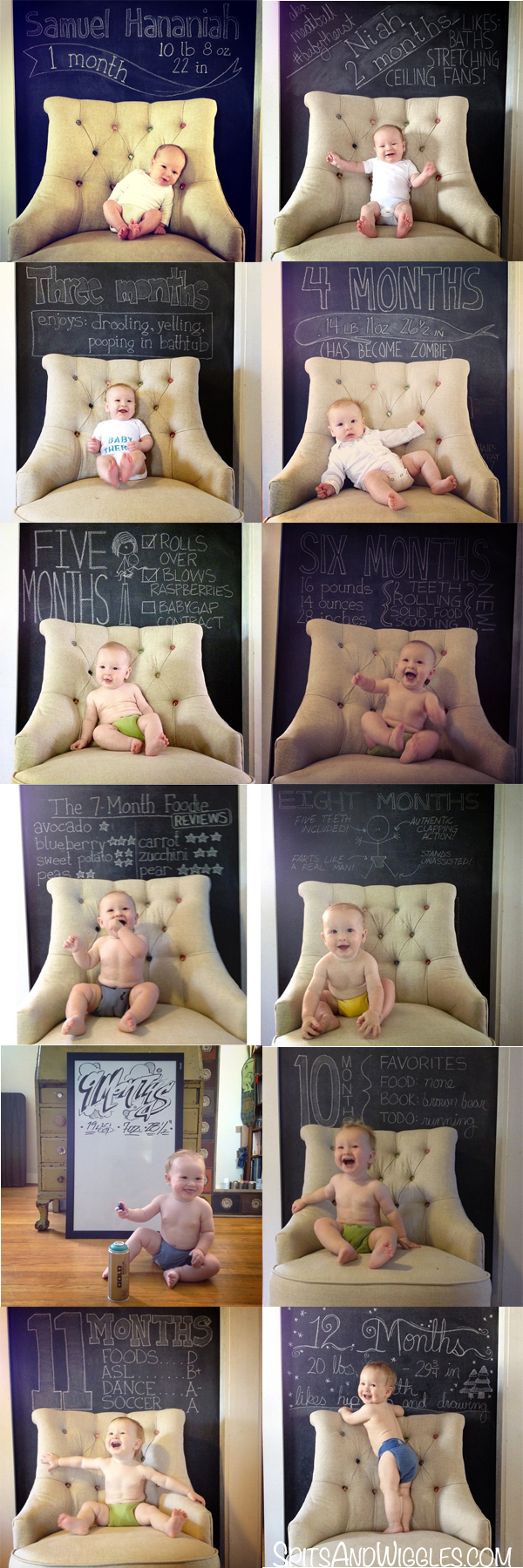
Sometimes I catch myself thinking it’s time for another baby. ‘Cause I wanted a baby, and this one is already a toddler. Not fair.
And then, inevitably, I immediately have a flashback of crouching next to the bed, or kneeling in the shower at the hospital, and wanting to die, and I think, “Ya … maybe not just yet.”
 Spits and Wiggles